 Atlanta (CNN)
 -- In this age of modern air travel, it was just a matter of when, not if.
A man at a Dallas hospital is the first person diagnosed with Ebola in the United States. Now, health officials are searching for those he came in contact with.
While they're trying to quell concerns about the disease spreading in the United States, they say they're leaving nothing to chance.
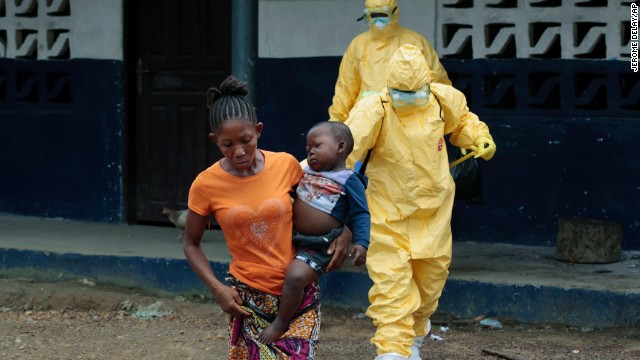
Marie Nyan, whose mother died of Ebola, carries her 2-year-old son, Nathaniel Edward, to an ambulance after showing signs of the virus in the Liberian village of Freeman Reserve on Tuesday, September 30. Health officials say the Ebola outbreak in West Africa is the deadliest ever. More than 3,000 people have died, according to the World Health Organization.Photos: Ebola outbreak in West Africa CNN reporter talks about covering Ebola Sanjay Gupta explains Ebola virus CDC: We will stop Ebola in its tracks Isolating the patient and paramedicsThe man flew from Liberia -- one of the Ebola hotspots -- and arrived in Dallas to visit family on September 20, said Dr. Thomas Frieden, director of the Centers for Disease Control and Prevention.
He started feeling ill about four days after arriving. That means fellow passengers were likely not at risk, since Ebola can only spread when the victim is showing active symptoms.
Frieden said the patient is now under intensive care and isolated at Texas Health Presbyterian Hospital.
And the crew members who transported the patient to the hospital have been isolated, Dallas Mayor Mike Rawlings' chief of staff said. They have not shown symptoms of the disease so far.
The ambulance used to carry the patient was still in use for two days after the transport, city of Dallas spokeswoman Sana Syed said.
But she stressed that just like after every transport, the paramedics decontaminated the ambulance according to national standards.
Tracking the contactsAfter he started showing symptoms but before he was isolated, the man had a handful of contacts with people, Frieden said.
A CDC team headed to Dallas to help investigate those contacts. But Frieden tried to mitigate concerns about the virus spreading.
'It is certainly possible that someone who had contact with this individual could develop Ebola in the coming weeks,' Frieden said. 'But there is no doubt in my mind that we will stop it here.' Ebola virus: 9 things to know about the killer diseaseHow the virus spreadsThe reason Ebola isn't being stopped
Alleviating fearsThere are several reasons why Americans are at extremely low risk for contracting Ebola.
Ebola is spread by direct contact with the bodily fluids of someone actively sick with the virus. It's not like a cold or the flu, which can be spread before symptoms show up. And it doesn't spread through the air.
That means people on the patient's fellow passengers on the plane aren't thought to be at risk, as he did not begin to show symptoms until several days after arriving in the United States, Frieden said.
On top of that, U.S. hospitals are better equipped to treat and isolate patients their counterparts in West Africa.
Trying to stop the global spreadWith planes criss-crossing the world every day, officials are trying to prevent symptomatic, contagious passengers from boarding in the first place.
The CDC has worked with airport authorities in Liberia, Sierra Leone, Guinea and Nigeria to make sure '100% of the individuals getting on planes are screened for fever,' Frieden said.
'And if they have a fever, they are pulled out of the line, assessed for Ebola and don't fly unless Ebola is ruled out.'
CNN's AnneClaire Stapleton, Chandler Friedman, Greg Botelho, Chelsea J. Carter and Ed Payne contributed to this report.
Post By http://ift.tt/1rLSxUk